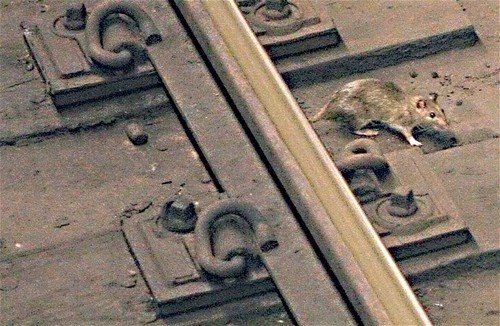
Subways fares aren't the only thing soaring these days. The subway's rat pack is increasingly taking platforms by storm.
"People have seen them sitting on benches," said Andrew Albert, an MTA board member and chair of the NYC Transit Riders Council, of the underground rodent problem. "From what riders have told us, they appear to be getting bolder.
Joel Sklar, a vice president at Assured Environments, one of the city's oldest and largest pest control companies, said he believes the subway rats have gotten more brazen for many reasons, including increased interaction with people.
"Next thing you know the doors are going to open and one is going to come on the train with us," said Sklar, who commutes by subway to Lower Manhattan. "If it happened would it shock me? No."
It's not easy being a lab rat. What's worse still is being a lab rat used for practice -- undergoing endless manhandling, injections and intubations, just so lab techs can get hands-on training. Is there no god?
To help ease the hard life of the lab rat, Craig Jones plans to release a furry, fully jointed rat mannequin, code-named "Squeekums," later this year as the newest training model in his Rescue Critters line. While Squeekums will never replace the live rats used in lab testing, it will allow technicians to learn how to handle rodents -- including safely inserting IVs and placing endotracheal tubes -- before they ever touch a real one.
Being able to help reduce the use of live animals in education and training drives Rescue Critters' president, Jones, to create the most lifelike animal training models on the market.
It's the plastic innards that make the mannequins viable stand-ins for living animals or cadavers. Disposable lungs expand the chest like a real patient's as they fill with air. An IV bag runs artificial blood into models' replica veins, allowing users to insert a needle and either inject or draw fluids.